Why Does Scorpio Have Three Symbols? The Strange History of the Scorpion, Eagle and Phoenix
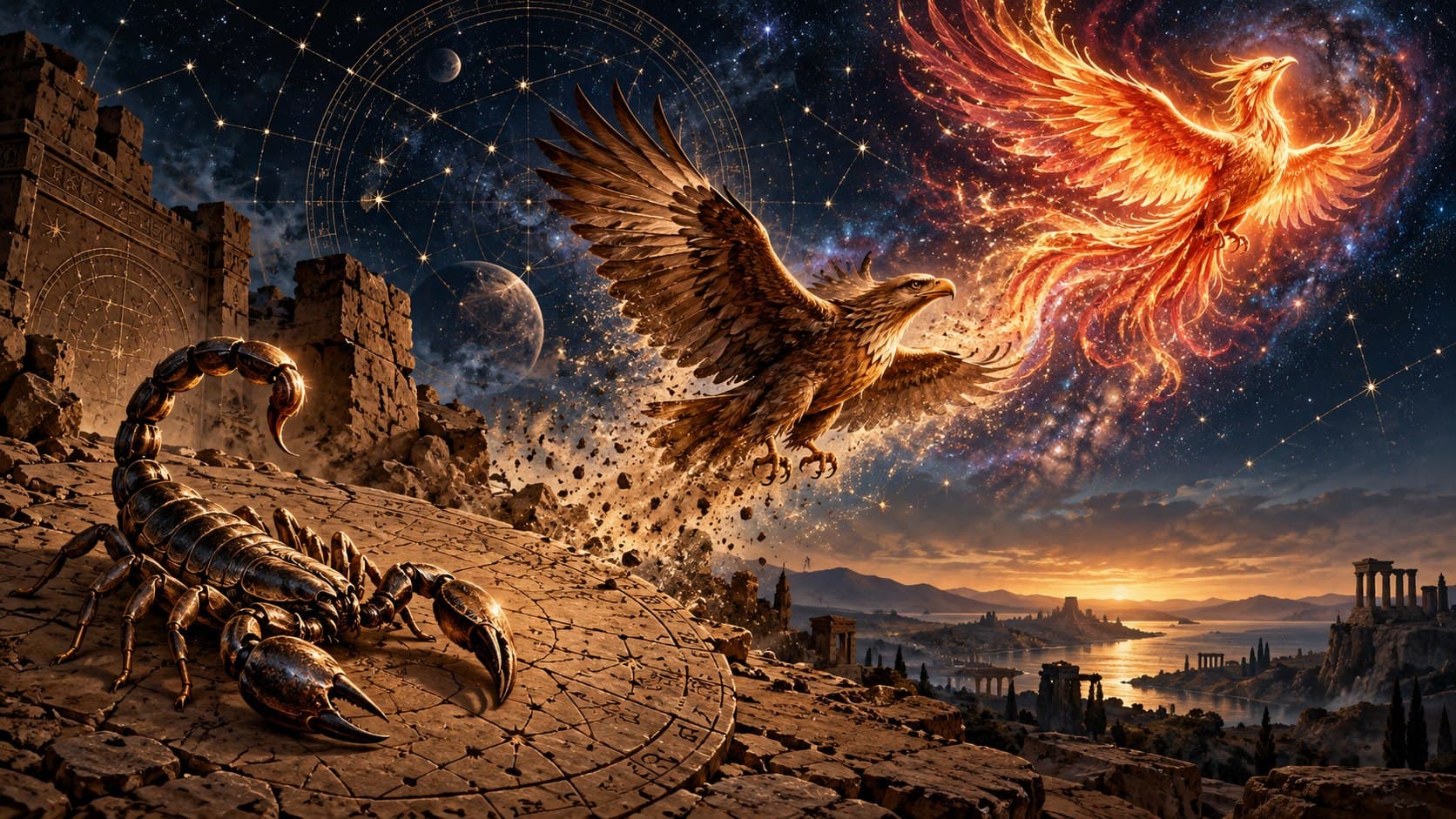
Ask what represents Scorpio and the first answer is easy: a scorpion. Keep asking and the sign starts shape-shifting. An eagle appears. Then a phoenix. Sometimes a serpent slips into the sequence too. Modern astrology often presents these creatures as three neat levels of Scorpio evolution—but the history is much messier, and much more interesting.
The short answer: the scorpion is the ancient zodiac image. The eagle came through a different symbolic tradition, especially the Christian “four living creatures” and later Western esotericism. The phoenix is later still. The familiar scorpion → eagle → phoenix ladder is best understood as a modern spiritual reading layered onto an old sign—not as one unchanged teaching handed down from Babylon.
1. The scorpion is the part that is genuinely ancient
Long before newspaper horoscopes, the part of the sky we call Scorpius was already imagined as a scorpion. A Smithsonian history of Arabic star maps describes the figure as Sumerian in origin and notes that it is among the most frequently depicted zodiac signs surviving from Babylonian material. The Metropolitan Museum of Art’s guide to medieval Islamic astronomy shows the continuity plainly: when Arabic and Iranian makers adapted Greek zodiac imagery, Scorpio was represented by a scorpion—not a phoenix and not an eagle.
That matters because it gives us a baseline. The scorpion is not a personality metaphor retrofitted to people born in late October. It is the inherited image of the sign itself. The later animals are interpretations of Scorpio; the scorpion is Scorpio’s old pictorial identity.
2. The sky contains a visual trick the myth remembered
Greek myth tied the constellation to Orion. In one surviving version, Orion threatened to kill every animal on Earth, so Gaia sent a giant scorpion that killed him. Zeus then placed both in the sky. The clever astronomical detail is that the enemies still avoid each other: as Scorpius rises, Orion sets. The ancient-source translations collected by Theoi’s Scorpius dossier preserve that exact explanation.
You can watch the geometry instead of taking the story on faith. Open Stellarium Web, search for Scorpius, advance the time until it climbs above the eastern horizon, and then look for Orion. The myth turns an ordinary consequence of Earth’s rotation into an eternal chase scene.
3. Ancient Scorpio was so large that it lost its claws
The modern constellation is only part of the older creature. The stars now assigned to Libra were once treated as the scorpion’s claws. The Paris Observatory’s history of constellation-making notes that the Babylonian Scorpio stretched across nearly 50 degrees before the Greeks turned the claws into the scales of Libra. Several star names still remember the older anatomy.
This is one reason the symbol’s history is easy to misunderstand. Zodiac images were never frozen illustrations. Civilizations translated, resized and reinterpreted them. But throughout those changes, the animal in the astronomical and ordinary zodiac tradition remained recognizably the scorpion.
4. The eagle entered through a different door
The eagle does not replace the scorpion in the familiar classical star catalogues. Its route is symbolic rather than cartographic. Christian art connected four winged creatures—a lion, bull, human and eagle—with the four evangelists. Esoteric writers later aligned that quartet with astrology’s four fixed signs: Leo as lion, Taurus as bull, Aquarius as human, and Scorpio as eagle.
That is a correspondence, not a rediscovered Babylonian label. The distinction is important. An eagle can be a meaningful emblem of Scorpio within an esoteric system without having been the original name of the constellation.
We can put at least one firm date on the modern trail. In his 1928 occult compendium The Secret Teachings of All Ages, Manly P. Hall called the eagle one of Scorpio’s three symbols and described the scorpion’s fire being transformed into spiritual light. That does not prove Hall invented the idea. It does prove the transformation reading was in print by the late 1920s.
5. The phoenix is the final—and least ancient—layer
The phoenix is almost irresistible once Scorpio has been made the sign of death, secrecy and regeneration. A creature that burns and returns from its own ashes supplies the perfect final image. Perfect symbolism, however, is not the same as ancient continuity.
Hall made the expanded scheme explicit in a 1945 essay, “The Bird of Wisdom and the Bird of War”. He actually listed four figures in ascending order: serpent, scorpion, eagle and phoenix, mapping them to earth, water, air and fire. Today’s popular three-stage version usually drops the serpent or merges its role into the scorpion. That variation is a clue: there was no single ancient syllabus with three compulsory Scorpio levels.
The useful historical conclusion is not “the three stages are fake.” It is that they are interpretive. They tell us how modern esoteric astrology learned to talk about inner transformation; they do not tell us what every ancient astrologer believed.
So what do the three Scorpio symbols mean today?
Used as a modern metaphor rather than a historical fact, the sequence is easy to understand:
The scorpion: defence, survival, suspicion and the reflex to strike when threatened.
The eagle: distance and perspective—the same intensity, but directed through observation rather than retaliation.
The phoenix: radical release and reconstruction: allowing an identity, attachment or pattern to end, then building something different.
This can be a compelling way to read a life story. It should not become a ranking system for people. Calling someone a “low-vibration scorpion” and yourself an “evolved phoenix” is spiritual vocabulary doing the work of an insult. The symbols are most useful when they describe choices a person can make, not permanent castes of Scorpio natives.
Scorpio the sign is not Scorpius the constellation
There is one more knot to untie. Western tropical astrology divides the ecliptic into twelve equal 30-degree signs. Modern astronomy defines 88 constellations as unequal regions of sky. So the astrological sign Scorpio and the astronomical constellation Scorpius share a history and a name, but they are not the same object.
NASA’s constellation explainer makes the scientific boundary clear: astronomy studies the physical universe using evidence; astrology is a cultural belief system whose predictive claims are not supported by scientific evidence. The International Astronomical Union’s constellation atlas is the right tool for the official sky region. Astrology tools answer a different, traditional question.
Try the idea instead of stopping at the article
If you want the sourced astrology layer, start with Bodhastra’s Scorpio evidence page. It keeps classical descriptions, modern personality language and disputed correspondences separate instead of blending them into one timeless profile. If you are unsure whether a date falls in Scorpio, the Bodhastra Sun-sign calculator computes the solar ingress rather than relying on a fixed date table. The full Western source ledger shows which books and publishers sit behind the claims.
For the physical sky, use Stellarium or the IAU chart. Put the two views beside each other and the whole subject becomes more interesting: one Scorpio is a measured region of stars; the other is a cultural object that has accumulated meanings for more than two millennia.
Why this story survives
Most zodiac signs get one memorable mascot. Scorpio gets a plot. The scorpion begins close to the ground, armed and defensive. The eagle rises high enough to see the larger pattern. The phoenix destroys the old form and returns remade. Whether or not you believe a birth chart describes a person, that narrative has real psychological elegance.
Its power may come precisely from being a later construction. Ancient star lore supplied the scorpion. Religious and occult symbolism supplied the eagle. Twentieth-century esotericism made the phoenix the climax. Modern astrology then compressed those layers into a story short enough to pass from book to blog to tattoo caption.
The better question, then, is not “Which Scorpio animal am I?” It is: “What happened to this symbol each time a new culture needed it to mean something more?” That question has no three-line horoscope answer—and that is exactly why it is worth asking.
Sources and transparency
The Metropolitan Museum of Art — medieval Islamic astronomy, astrology and zodiac imagery
Paris Observatory digital library — the changing boundaries and images of constellations
Theoi Classical Texts Library — translated Greek and Roman passages about Orion and Scorpius
Manly P. Hall, 1928 — documentary evidence for the eagle as an esoteric Scorpio symbol
Manly P. Hall, 1945 — an explicit serpent/scorpion/eagle/phoenix hierarchy
NASA Space Place and the IAU — the astronomy/astrology distinction and modern constellation boundaries
Cover art is an original AI-assisted illustration generated for GlitchBong. It is symbolic editorial art, not a reconstruction of a historical artefact. This article treats astrology as cultural and intellectual history; it does not present astrological personality or predictive claims as scientific findings.
Frequently asked questions
Why does Scorpio have three symbols?
Modern esoteric astrology uses the scorpion, eagle and phoenix as a transformation sequence: defence and survival, perspective and control, then destruction and renewal. The sequence combines an ancient zodiac animal with later religious and occult symbolism.
Is the phoenix an ancient symbol of Scorpio?
The phoenix itself is ancient, but the evidence for a fixed scorpion–eagle–phoenix Scorpio ladder is much later. Twentieth-century occult writing documents the full hierarchy clearly; ancient and medieval zodiac imagery normally shows Scorpio as a scorpion.
What is the highest stage of Scorpio?
In the popular three-stage model, the phoenix is the final stage and represents regeneration after a symbolic death. That is a modern spiritual interpretation, not a scientifically measurable level or a universal rule across astrological traditions.
Are Scorpio and the constellation Scorpius the same?
No. Tropical astrology’s Scorpio is an equal 30-degree sign. Astronomical Scorpius is an unequal, officially bounded region of the sky. They share historical imagery, but modern astrology and astronomy define them differently.