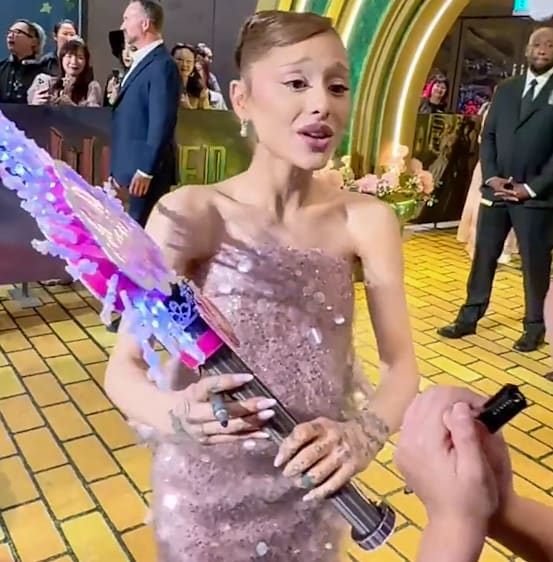
the second half, the darker half, and the one that gave glinda a song of her own that did not exist on stage.
the short answer
the second half of jon m. chu's two-part adaptation, released on 21 november 2025. it opened to $150 million domestically and $226 million worldwide — the biggest opening ever for a broadway adaptation — and finished above $540 million. it contains two songs written for the film by stephen schwartz, one of them, the girl in the bubble, for grande's glinda.
what the second half is
act two of the stage musical, which is a considerably harder piece of material than act one. the first film is a friendship forming; this one is that friendship failing under political pressure, with elphaba in exile and glinda occupying the position of official goodness in a regime she knows to be lying. it is darker, slower and less immediately pleasurable, and the reviews reflected that.
it is also the half that asks the most of glinda. the first film gave grande a comic role with a technical singing part underneath it. this one gives her a character who spends most of the running time complicit and aware of it, which is a different job entirely.
the two new songs
stephen schwartz wrote two songs that do not exist in the stage version. no place like home goes to elphaba. the girl in the bubble goes to glinda, and it is the first time in the property's twenty-year history that the character has had a solo number about her own position rather than about the plot.
the ending, explained
glinda returns to the emerald city after the melting and hands the wizard a green bottle that belonged to elphaba's mother, which he recognises — it establishes that elphaba is his daughter. she exiles him from oz, sends him off with dorothy, and then deals with madame morrible, having her taken to the cages that once held the animals she helped imprison.
elphaba is not dead. the melting was staged — a trapdoor, and fiyero, alive as the scarecrow, waiting on the other side of it. the two of them leave for whatever is beyond oz, and glinda never learns. the last image is a flashback to the pair of them at shiz, which recreates the musical's poster.
the cruelty of the ending, and the reason it works, is that glinda's grief is real and unnecessary and she carries it for the rest of her life. she does the right thing at every turn in the last twenty minutes and gets nothing for it.
the money
| measure | figure |
|---|---|
| opening weekend, domestic | $150m |
| opening weekend, worldwide | $226m |
| domestic total | about $343m |
| worldwide total | about $540m |
the opening was the largest ever recorded for a broadway adaptation, beating the first film's own record from a year earlier. it did not sustain at the first film's rate, which is the usual shape for a part two of anything.
the awards
grande took a second golden globe nomination for best supporting actress, and did not win. the more consequential result came at the grammys in february 2026, where defying gravity — recorded for the first film, sung live on set — won best pop duo/group performance, giving her a third grammy. the full awards record is here.
questions people ask
when did wicked: for good come out?
21 november 2025. it is the second half of jon m. chu's two-part adaptation.
what are the new songs in wicked: for good?
two, written by stephen schwartz for the film: no place like home for elphaba, and the girl in the bubble for glinda.
does elphaba die at the end of wicked: for good?
no. the melting is staged, and she leaves oz with fiyero. glinda never finds out and grieves for her.
how much did wicked: for good make?
about $540 million worldwide, from a $226 million opening weekend — the biggest opening ever for a broadway adaptation.