SQL Dialects Explained: MySQL vs PostgreSQL vs SQL Server. MySQL, PostgreSQL and SQL Server Don't Speak the Same Language
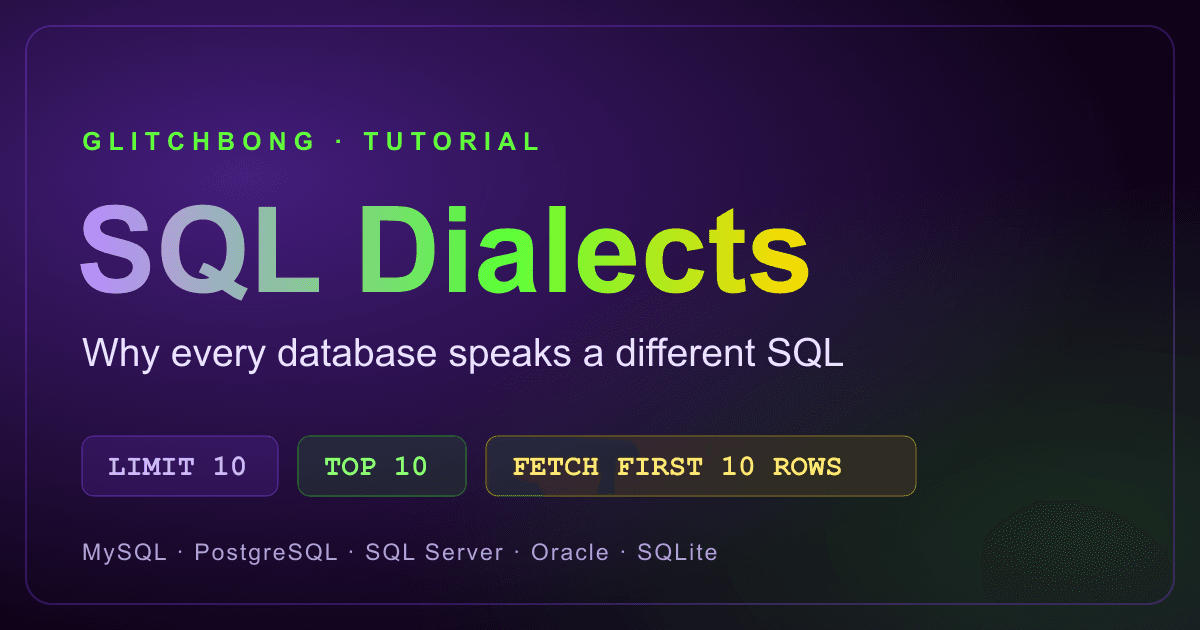
You learned SQL once and felt unstoppable — until you switched databases and LIMIT 10 suddenly threw a syntax error. Welcome to the quiet frustration every developer eventually hits: SQL isn't one language. It's a family of dialects that only pretend to get along.
Isn't SQL supposed to be a standard?
It is — on paper. There's an official ANSI/ISO standard, and every database claims to follow it. In reality, each vendor implemented the parts it liked and bolted on its own extensions. So the basic SELECT … FROM … WHERE is portable, and almost everything interesting quietly diverges.
The differences that trip everyone up
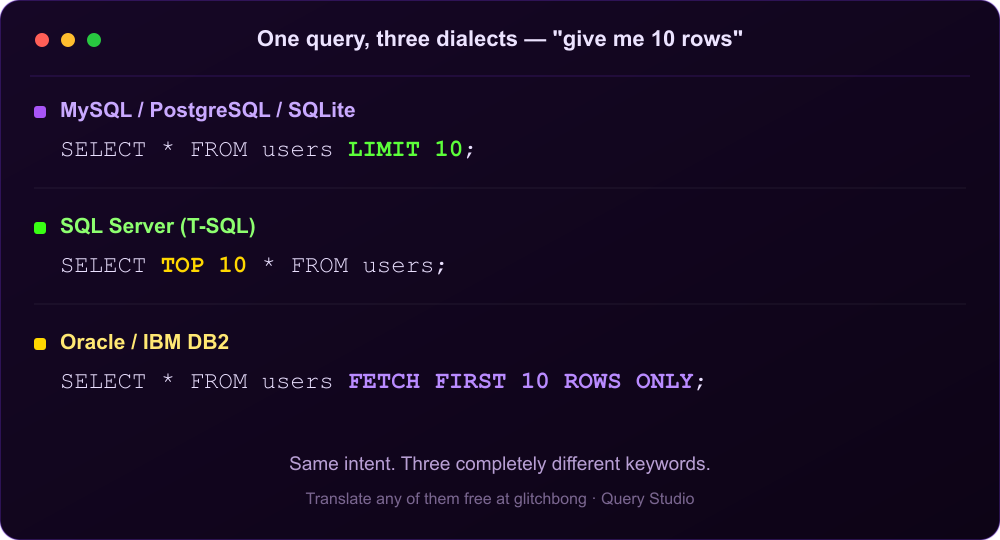
Limiting rows
- MySQL / PostgreSQL / SQLite:
SELECT * FROM users LIMIT 10 - SQL Server:
SELECT TOP 10 * FROM users - Oracle / DB2:
… FETCH FIRST 10 ROWS ONLY
Quoting identifiers
- MySQL / MariaDB: backticks —
`order` - PostgreSQL / Oracle: double quotes —
"order" - SQL Server: brackets —
[order]
Handling NULLs
Same feature, four names: MySQL's IFNULL(), SQL Server's ISNULL(), Oracle's NVL() — and COALESCE(), which works everywhere. When in doubt, reach for COALESCE.
The current date & time
NOW() in MySQL and PostgreSQL, GETDATE() in SQL Server, SYSDATE in Oracle — or the portable CURRENT_TIMESTAMP that they all understand.
Auto-incrementing IDs
AUTO_INCREMENT (MySQL), SERIAL (PostgreSQL), IDENTITY(1,1) (SQL Server), AUTOINCREMENT (SQLite) — four ways to say "just number the rows for me."
Rule of thumb: learn the ANSI-standard forms once —COALESCE,CURRENT_TIMESTAMP,CAST()— and you'll write queries that run almost anywhere.
So why does this happen?
Databases evolved over decades, each solving real problems before the standard caught up. Once millions of queries depend on GETDATE(), you can't just delete it. The standard is a floor, not a ceiling — and every engine builds a different house on top of it.
How to stop memorising all of it
You don't need every dialect in your head. When you're moving a query between databases, don't hand-edit quotes and functions — let a tool do it. I built Query Studio, a free, no-login SQL translator that rewrites row limiting, identifier quoting, NULL handling and date functions automatically. For specific migrations there are dedicated converters too, like MySQL to PostgreSQL and SQL Server to PostgreSQL. Paste a query, pick two databases, and copy back working syntax.
New to SQL? Learn it from scratch
If you're just getting started, these free resources teach SQL from the ground up — bookmark them:
- W3Schools SQL Tutorial — the classic beginner's guide to standard SQL, with a "Try it Yourself" editor in the browser.
- W3Schools MySQL Tutorial — SQL as spoken by MySQL, the world's most popular open-source database.
- PostgreSQL Official Tutorial — a gentle, hands-on intro straight from the Postgres docs.
- Microsoft T-SQL Reference — the go-to reference for SQL Server's dialect.
FAQ
What is a SQL dialect?
A database vendor's own version of SQL — the standard core plus that engine's extra syntax and functions. MySQL, PostgreSQL, SQL Server and Oracle each have their own.
Is SQL the same in every database?
No. Basic queries are portable, but row limiting, identifier quoting, NULL handling, date/time functions and auto-increment syntax all differ between databases.
How do I convert a query between SQL dialects?
Use a translator like Query Studio: pick the source and target databases, paste your query, and it rewrites the parts that differ — instantly and free.